America 250: The War of 1812 Triptych, 2026
The following three paintings were created especially for 25 Decades, a novel exhibition at the Community Arts Center in Wallingford, PA. Each exhibiting artist would create work representing a different decade in US history as part of the year-long America 250 celebrations being held in and around Greater Philadelphia in 2026.
I represented the years 1806-1815 and focused on events that occurred during the War of 1812.
Contact me for purchase inquiries.

The War of 1812: Battle of Sacket's Harbor. May 28-29, 1813
Oil and scenic latex on reclaimed muslin. 24 x 24"
2026
On May 27th, 1813, British naval forces were deployed from lower Canada, crossing Lake Ontario to New York State. They arrived on May 28th with the intention of capturing Sacket's Harbor, a significant dockyard on the American side of the lake. While the battle ended with an American victory, much of the village of Sackets Harbor was destroyed by friendly fire.
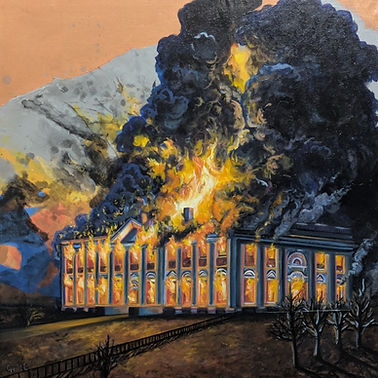
The War of 1812: Burning of Washington, August 24th 1814 (after Tom Freeman)
Oil and scenic latex on reclaimed muslin. 24 x 24"
2026
From August 24th-25th, 1814, British forces invaded Washington DC, where they proceeded to set fire to- and ultimately destroy- the White House, Capitol, and other government buildings. President James Madison fled to Brookeville, Maryland which became "Capital for a Day." This event, often referred to as the "Capture of Washington," is the only time since the American Revolutionary War that a foreign power has captured and occupied an American capital.

The War of 1812: Battle of Baltimore, September 12-14, 1814, and the Star-Spangled Banner
Oil and scenic latex on reclaimed muslin. 24 x 24"
2026
While imprisoned by the British during the attack on Fort McHenry in Baltimore, lawyer and amateur poet Francis Scott Key was famously inspired to write a poem called "The Defence of Fort M'Henry." The poem described Key's relief and amazement of seeing the American Flag still flying over Fort McHenry after the smoke began to clear (signaling an American victory). His verses were later set to the tune of a British song called "To Anacreon in Heaven." In 1931, Congress officially adopted what is now known as "The Star-Spangled Banner" as the country's National Anthem.
